

The UK Research Institute in Secure Hardware and Embedded Systems (RISE) aims to bring together the hardware security community in the UK to build a strong network of national and international research partnerships, accelerating the industrial uptake of research outputs and its translation into new products, services and business opportunities for the wider benefit of the UK economy. RISE is funded by the Engineering and Physical Sciences Research Council and the National Cyber Security Centre. It is hosted by the Centre for Secure Information Technologies (CSIT), Queen’s University Belfast.
RISE Impact Competition 2026
We are launching a new impact competition for 2026. Please visit the information page to find out more and apply!
RISE Call for Workshops
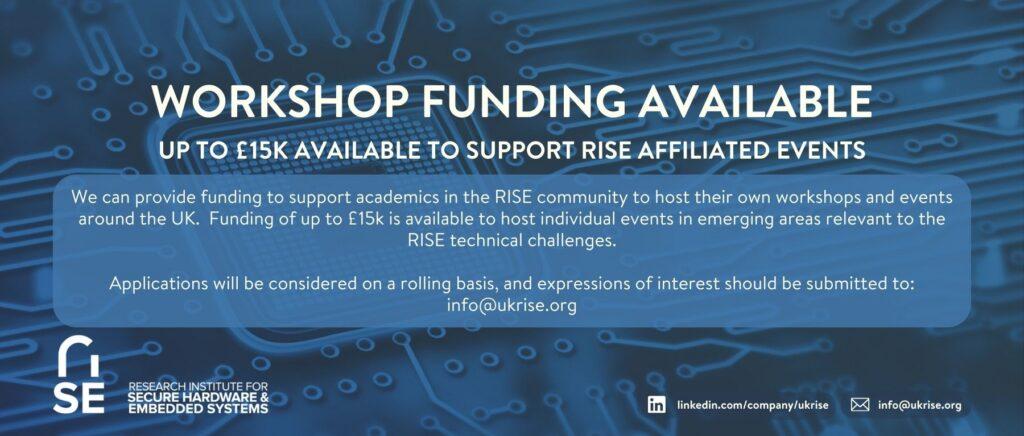
Could you benefit from up to £15K of funding support for events that would be relevant to emerging areas of the RISE technical research challenges? If so please email expressions of interest to info@ukrise.org.


TruDetect: Trustworthy Deep-Learning based Hardware Trojan Detection
Prof Máire O’Neill, Dr Ihsen Alouani, Dr Niall McLaughlin, Queen’s University of Belfast
CHERI memory protection: pathways to industrial adoption
Prof Robert Watson, Prof Simon Moore, Prof Peter Sewell, Dr Peter Neumann, Brooks Davis, University of Cambridge
Quantum-Driven crypto primitives at the heart of Hardware Root of Trust (HRoT)
Ranga Desikachari, Crypto Quantique
Single-Stepping Attacks and Defences for Confidential VMs
Luca Wilke, University of Lübeck
Towards Secure Integrated Semiconductor Systems
Prof John Goodenough, University of Sheffield
SECCOM: Securing Composable Hardware Platforms
Prof John Goodacre, Prof Lucas Cordiero, University of Manchester
IOTEE: Securing and analysing trusted execution beyond the CPU
Dr Ahmad Atamli, Prof Vladi Sassone, Peiyao Sun, University of Southampton, Prof David Oswald, Prof Mark Ryan, University of Birmingham
Ahoi Attacks: Breaking Confidential VMs with Malicious Interrupts
Dr Shweta Shinde, ETH Zurich
Building secure hardware with Open Silicon at lowRISC
Dr Greg Chadwick, lowRISC
How to work with industry
Dr Carl Shaw, Codasip
Relentless evaluation of the foundational security of AWS Nitro systems early in the design
Rene Henriquez and Dr Zitai Chen, Amazon Web Services
Leaky Abstractions
Dr Alastair Reid – Senior Principal Engineer at Intel.
DPU Technology – Redefining next generation Datacenter Security
Prof Sakir Sezer – Queens University Belfast
Adaptive Trust Principles: the Foundation of Next Generation Vehicle
Shadi Razak – CTO at Angoka
Panel Session: Research to Reality
Louise Cushnahan, Shadi Razak, James Patrick Evans, Osney Capital
Protecting IoT in the Wild
Keith Graham – Head of University Program at Codasip
To Trusted Hardware (and back again?)
Hugo Vincent – Head of Security Group at Arm Research
Digital Security by Design, Challenge Update
Prof John Goodacre – Challenge Director at DSbD
A Deep Dive into FPGA Technology from a Security Perspective
Prof Dirk Koch, Heidelberg University
Practical and Formal Analysis Security of Contactless Mobile Payments
Dr Ioana Boureanu, University of Surrey
5G: Security from start to finish
Aaron Hogan - Engineering Director, Qualcomm
A Stab in the Dark: Blind attacks on the Linux Kernel
Professor Herbert Bos, VUSec Systems Security research group, Vrije Universiteit Amsterdam
IOSEC: Protection and Memory Safety for Input/Output Security
SCARV: A Side-Channel Hardened RISC-V Platform
User-controlled hardware security anchors: evaluation and designs
DeepSecurity: Applying Deep Learning to Hardware Security
rFAS: Reconfigurable FPGA Accelerator Sandboxin
SafeBet-Memory capabilities to enable safe, aggressive speculation in processors
GUPT: A Hardware-Assisted Secure and Private Data Analytics Service
TimeTrust: Robust Timing via Hardware Roots of Trust and Non-standard Hardware, with Application to EMV Contactless Payments
Mind the Gap: Promises, Pitfalls and Opportunities of Hardware-Assisted Security
Ahmad-Reza Sadeghi, TU Darmstadt
Hardware based Lightweight Authentication for IoT Applications
Gang Qu, University of Maryland
Perspectives on hardware security: embedding it everywhere, continuously and inexpensively
Massimo Alioto, National University of Singapore
PUF: From Research to Practice
Chongyan Gu, Queen’s University Belfast
Winning the War in Memory
Simon Moore, University of Cambridge
ARM's perspective on the importance of hardware security research
Richard Grisenthwait, ARM
CHERI - Architectural support for memory protection and compartmentalisation
Robert Watson, University of Cambridge
Accelerating Innovation
Louise Cushnahan, CSIT, Queen’s University Belfast
Why, Who, How and Where of Standards!
Charles Brookson, OBE
How to use Deep Learning for hardware security testing
Marc Witteman, Riscure
Software-based Microarchitectural Attacks
Dr Daniel Gruss, Graz University of Technology
Physical Attacks: Towards combined threat, protection and beyond
Shivam Bhasin, David Berend, Nanyang Technical University Singapore